Author: Joshua Adeleye

  • From Hype to Headache: Rúben Amorim Is Sinking at Manchester United—And the Numbers Prove It

    From Hype to Headache: Rúben Amorim Is Sinking at Manchester United—And the Numbers Prove It

    A rigid system in a volatile environment is turning United into a bomb club not a bomb squad

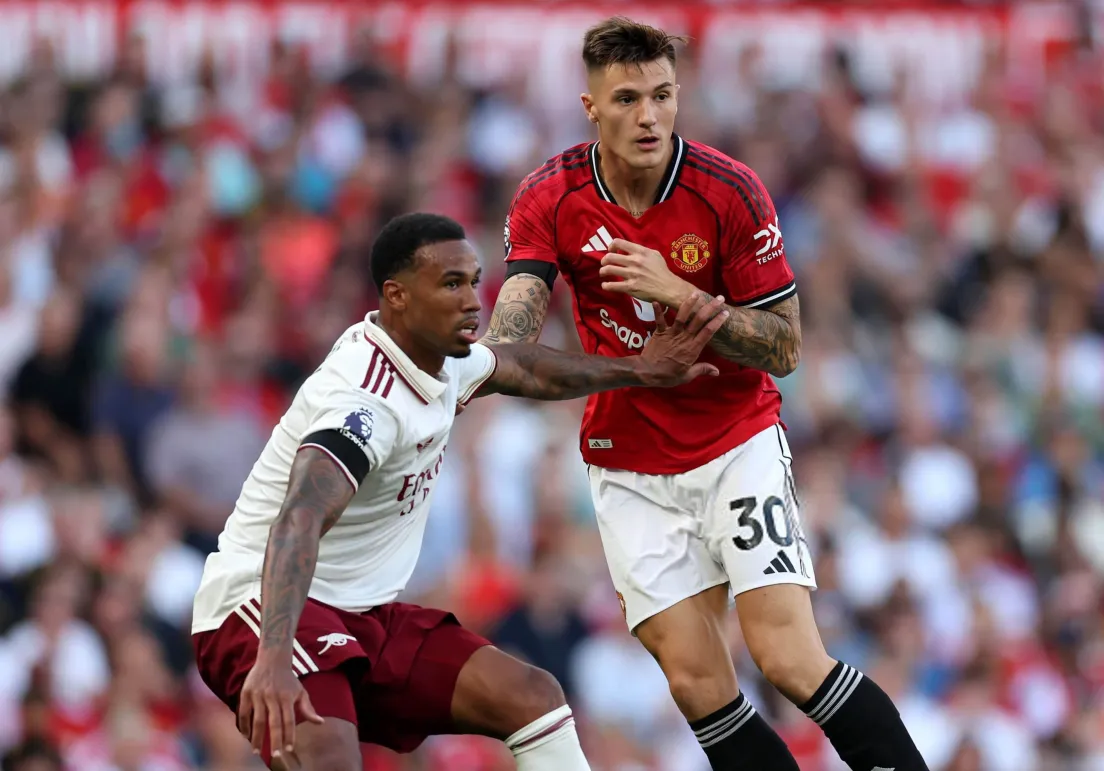
    Amorim has inherited, then doubled down on instability. United have gone three straight windows investing in “development” No.9 profiles: Rasmus Højlund in 2023, Joshua Zirkzee in 2024, and now Benjamin Šeško in 2025, while also adding Bryan Mbeumo and Matheus Cunha to remake the attack. That’s £200m+ this summer alone for Mbeumo (£70m), Cunha (£62.5m), and Šeško (up to ~£73.7m). ESPN.com+2ESPN.com+2The Guardian

    The idea: accelerate a vertical, pressing 3-2-5/3-4-2-1. The reality: two league matches, one point, and a cup exit to League Two Grimsby on penalties. The problem isn’t courage in the motivational sense; it’s tactical courage; the willingness to bend the blueprint when the game demands it. Right now, Amorim isn’t bending.


    Match Evidence: Arsenal 1–0 and Fulham 1–1 show the same structural leaks

    What the tape and numbers say:

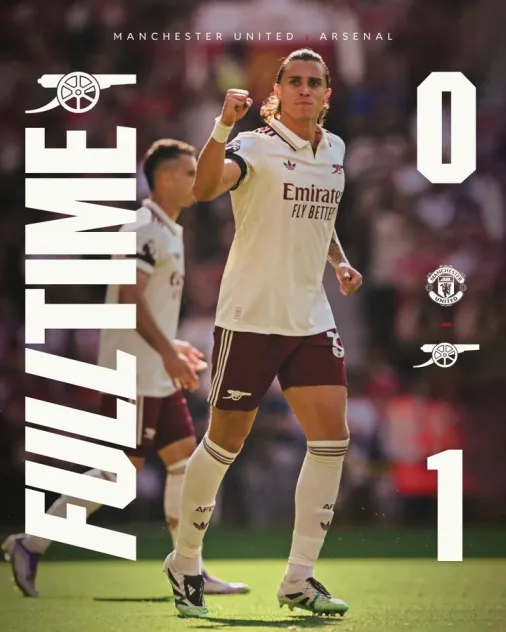
    Arsenal at Old Trafford (Aug 17, 2025)

    • xG: United 1.33 vs Arsenal 1.38
    • Shots: United 9 vs Arsenal 22
    • PPDA (lower = more intense press): United 7.90 vs Arsenal 13.45
      United pressed fairly well but were territorially overwhelmed and out-shot 22–9. The 0–1 felt less like bad luck and more like a team that couldn’t scale possession or chance volume once behind.

    Fulham at Craven Cottage (Aug 24, 2025)

    • xG: Fulham 1.65 vs United 1.55
    • Shots: Fulham 13 vs United 10
    • PPDA: United 10.89 vs Fulham 9.93
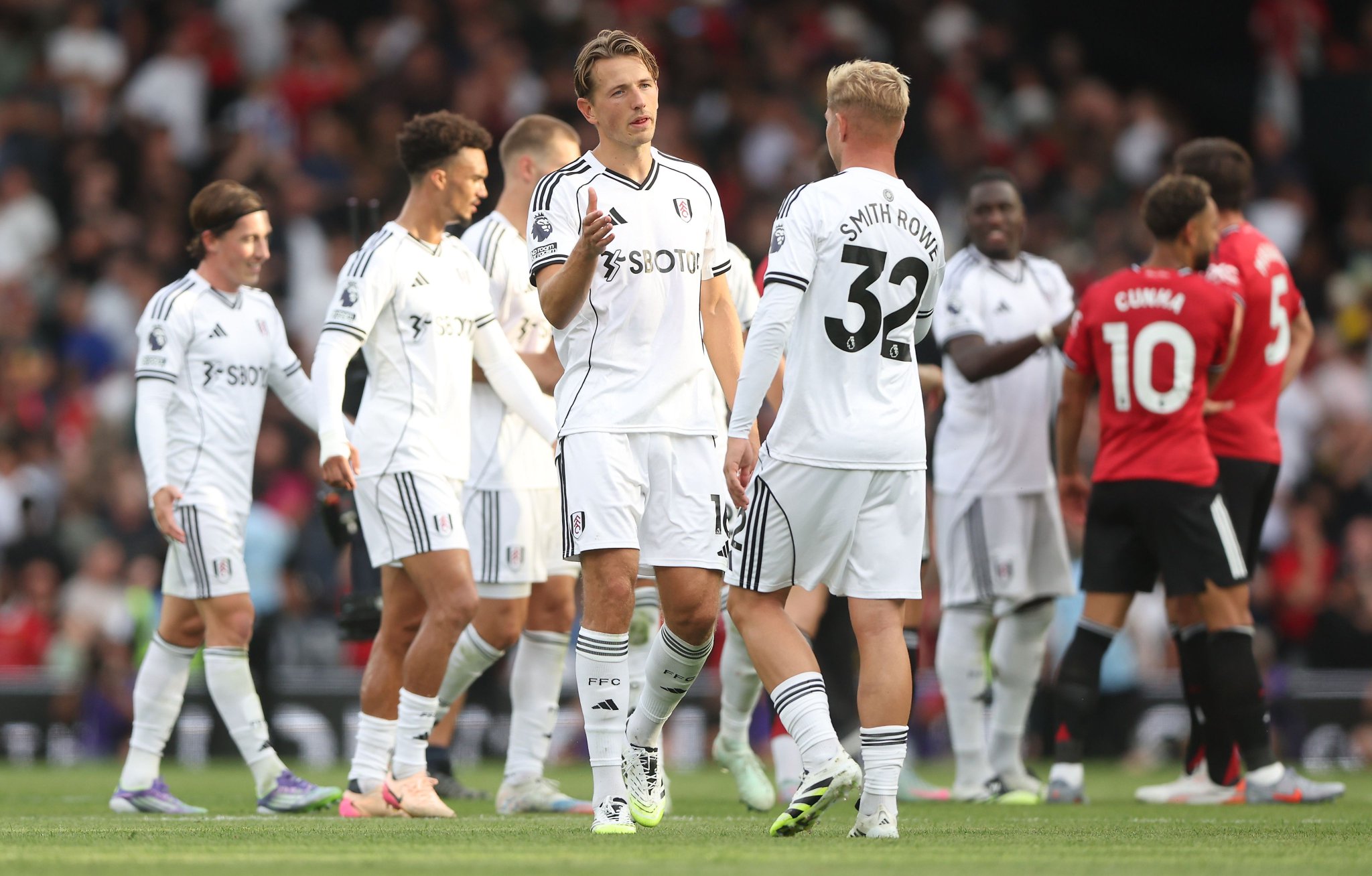
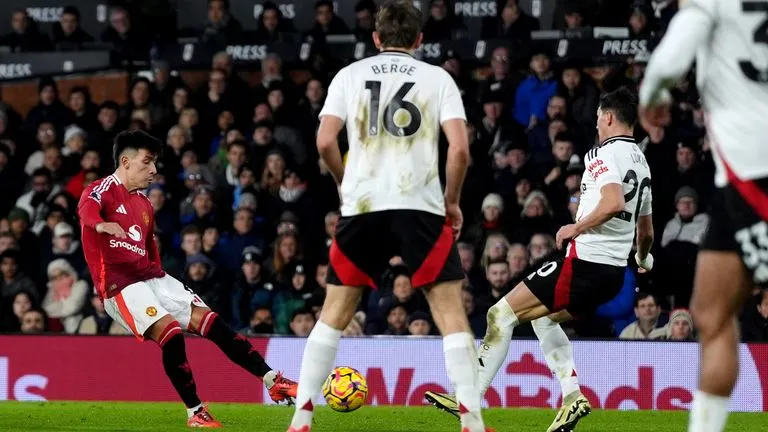
      United led 1–0, then sank into a passive 5-2-3, conceded territory, and were pegged back by an Iwobi → Smith Rowe combo. Bruno Fernandes missed a first-half penalty. This was a toss-up on xG, but the game-state management collapsed.

    The Systemic Diagnosis: Why the 3-4-2-1 keeps turning passiv

    1: Vertical stretch under pressure
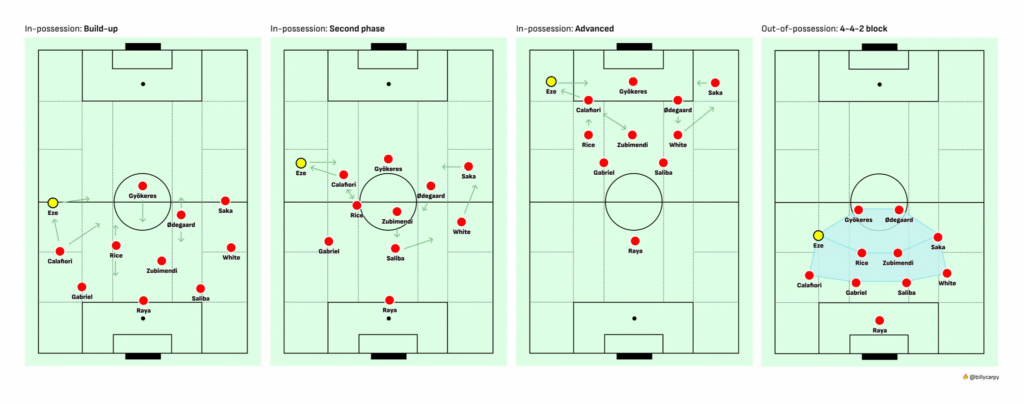
    On team sheet it’s a back three; under stress it becomes a back five with big gaps to the front line. United’s wing-backs get pinned, the “box” midfield flattens, and opponents access half-spaces and switches—exactly how Fulham grew after the break. The Understat event maps and PPDA illustrate the drop in access to the ball once United led.

    2: Pressing asymmetry
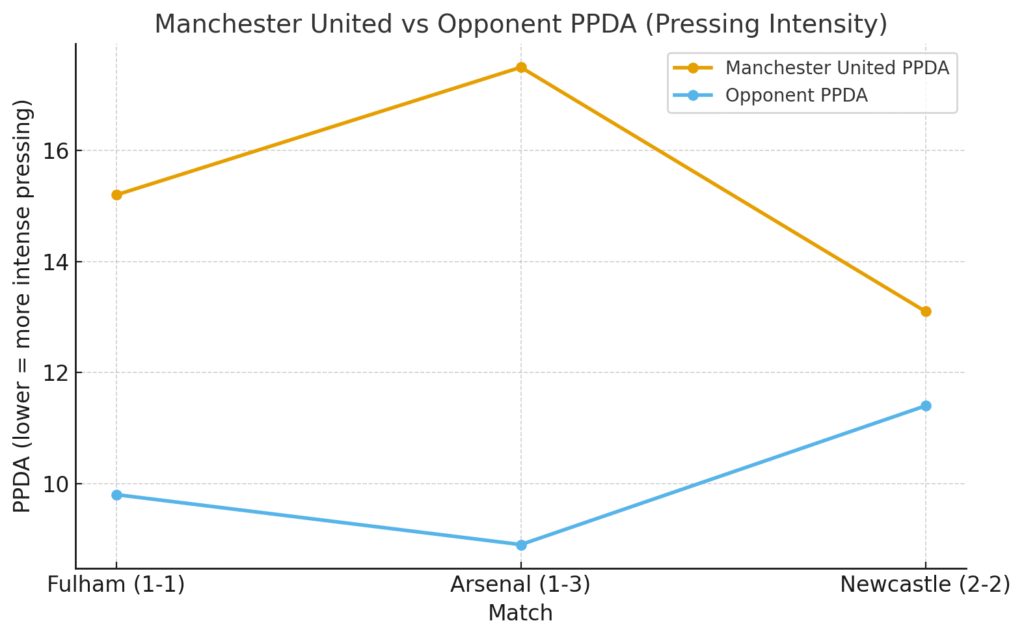

    The PPDA split tells you United’s press wasn’t synchronized at Fulham (10.89 is mid-table intensity). At Arsenal it was sharper (7.90) but couldn’t translate into shot volume or territory. A high press that doesn’t connect to compact rest-defence just creates longer defensive transitions.

    3: Chance creation profile mismatch
    Šeško wants early depth runs, Mbeumo lives on far-post diagonals and half-space carries, Cunha links between lines. Those patterns are doable—but only if the back five doesn’t retreat and the double-10s can pin and bounce. The shot totals and xG tell you United aren’t getting enough repeatable touches into those zones yet. ESPN.com+1The Guardian


    The Human Factor: Courage vs stubbornness

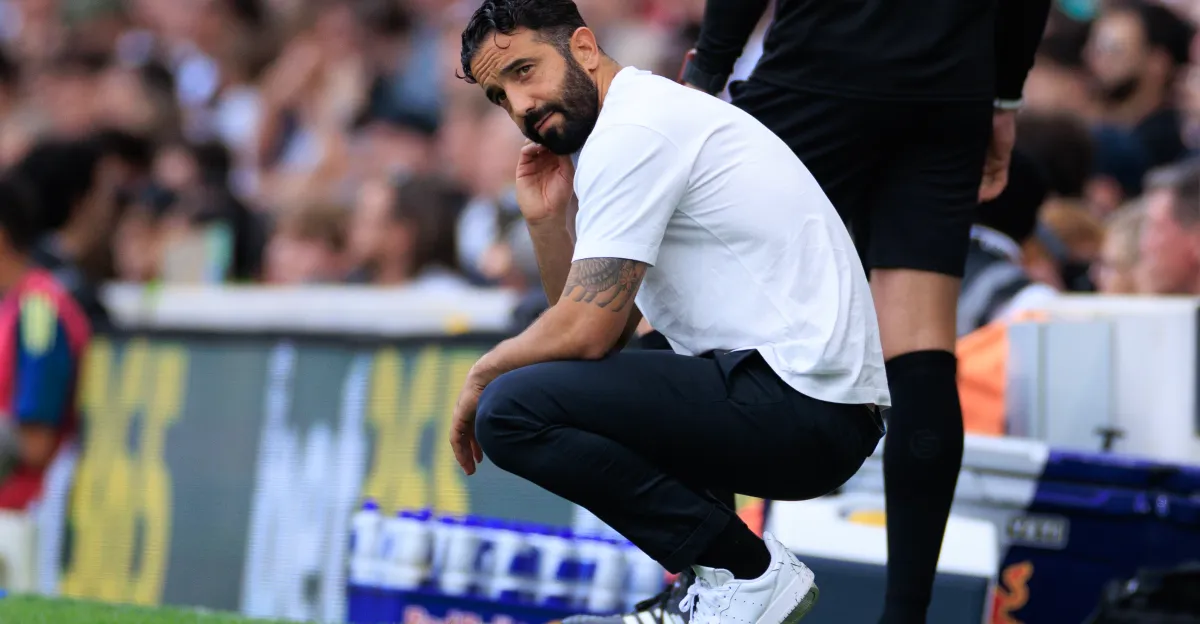
    Amorim keeps signalling he won’t move off the core structure. That’s where the “lacks balls” critique lands: bravery here would be proactive adjustment—compressing lines when leading, flipping to a 4-3-3/4-2-3-1 to regain midfield access, or staggering one wing-back deeper to keep the rest-defence intact. The best managers flex the shape to the game state. Right now, United are rigid when flexibility would be braver.


    Instability Off The Pitch: From development 9s to a forward exodus
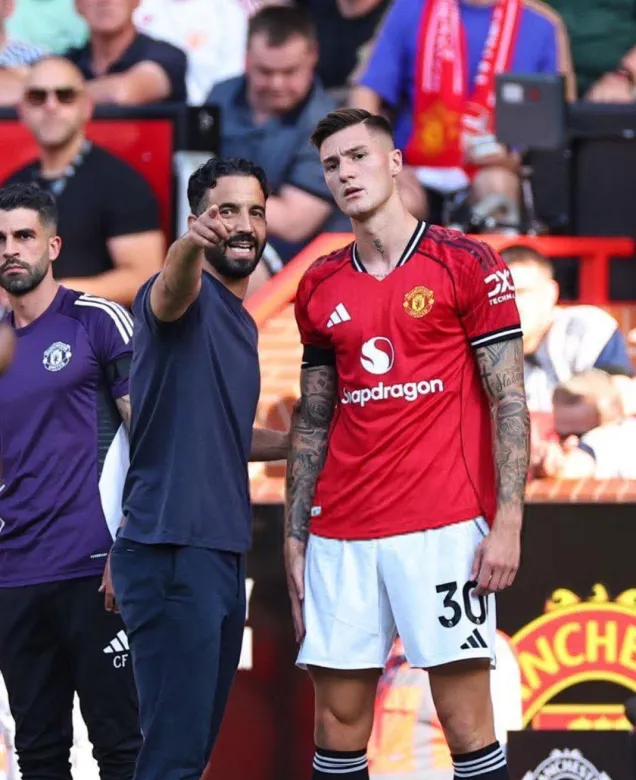
    • Three consecutive “development” 9s: Højlund (2023), Zirkzee (2024, ~£36.5m), Šeško (2025, up to ~£73.7m). United keep onboarding potential rather than peak. Sky SportsThe Guardian
    • This summer’s outflow signals:
      • Rashford registered by Barcelona and already debuting.
      • Højlund → Napoli talks active.
      • Garnacho → Chelsea moving toward £35–40m.
        These aren’t academy loans; they’re core-talent exits circling an uncertain project, and they strip the squad of known outputs and identity. Yahoo Sports+2Yahoo Sports+2We Ain't Got No History
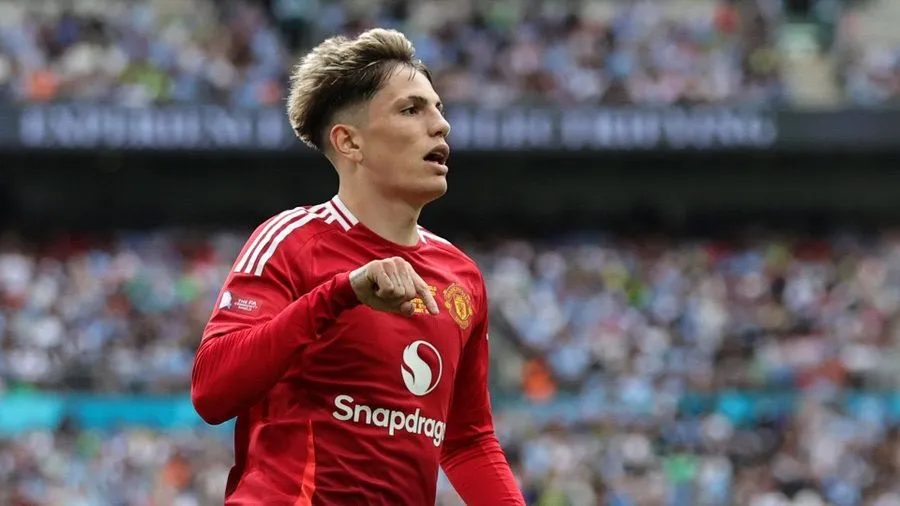
    Garnacho context: 2023/24 delivered double-digit goal contributions; 2024/25 in the league he logged 6G+2A, with career totals at United reported as 26G and 22A. Selling a 21-year-old academy winger who “never hid” for ~£35–40m is poor value amid chaos. Manchester UnitedStatMuseTalkSport


    The Grimsby Red Flag: Process under pressure
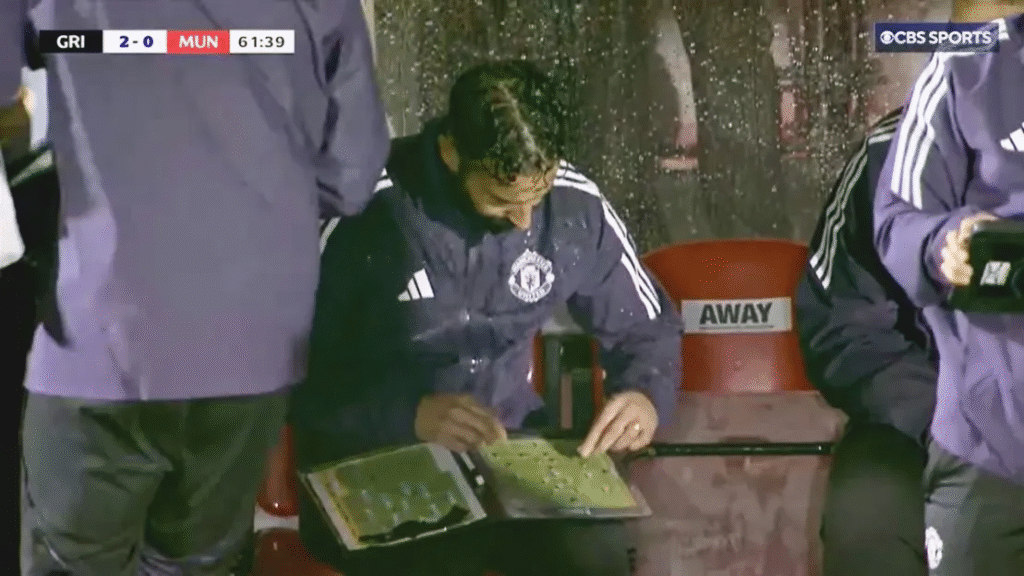
    Manchester United’s Carabao Cup humiliation came at the hands of League Two side Grimsby Town, ending 2–2 after 90 minutes before a marathon shootout finished 12–11. The penalty chaos underlined deeper problems: United’s new-look forward line shrank under the spotlight. Benjamin Šeško, signed for over £70m and billed as the leader of the next generation, stepped up only for the tenth spot-kick—a strange optic for a striker meant to set the tone.


    What Needs To Change: Concrete, coachable fixes
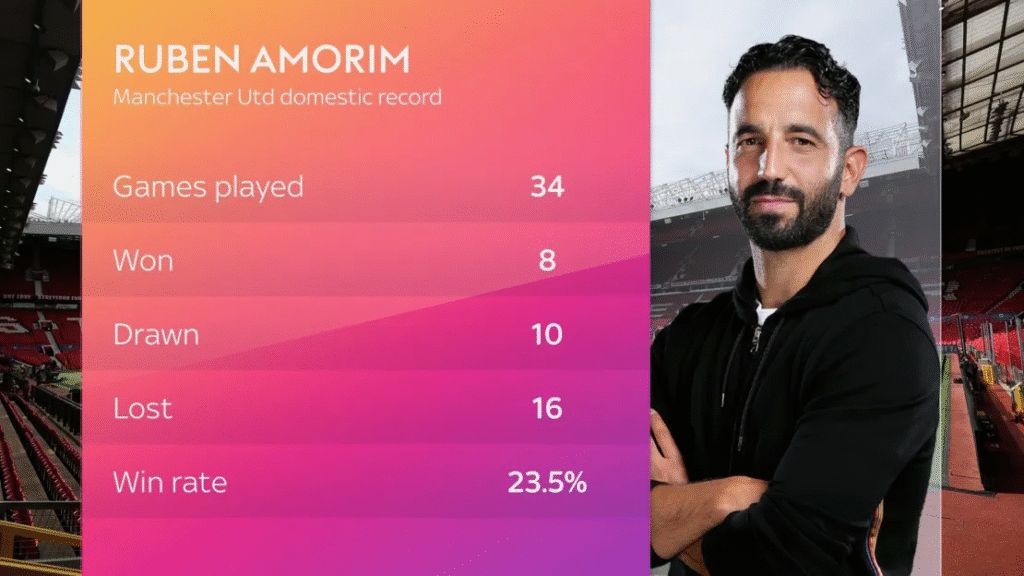
    Compress the block late in games: Keep the front five connected by dropping a 10 to form a 3-3 rest-defence and prevent the slide into a passive 5-2-3. You can see from Fulham’s PPDA and shot trend when United lost access.

    Codify three A-to-B patterns to feed the new front line:

    • Early diagonal into Šeško stride with strong-side 10 arriving second phase.
    • Far-post isolation for Mbeumo from weak-side wing-back switches.
    • Wall-pass triangles with Cunha to release an underlap. The signings justify these patterns; the current data shows they aren’t repeatable yet. ESPN.com+1

    Pressing triggers: Standardize the first jump (ball near CB), the cover shadow from the near 10, and the starting height of the ball-far winger. Arsenal’s match PPDA shows United can press; Fulham shows they can’t sustain it across game states.

    Penalty order leadership: Put your best two takers in the first three. The Grimsby shootout optics matter for dressing-room hierarchy and public confidence. Premier League


    Bottom Line: Can Amorim learn fast enough
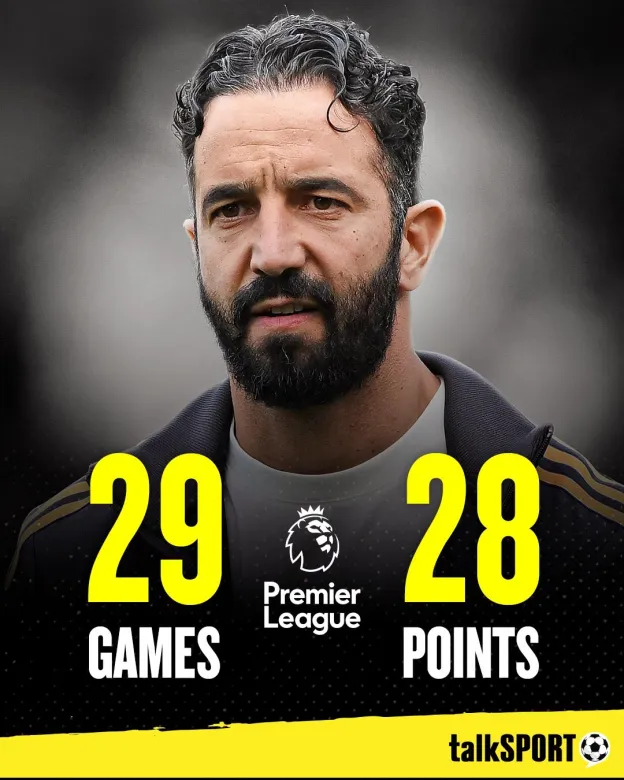
    United’s early-season sample is small but loud. The xG is close, the shots against are heavy, and the press evaporates when protecting a lead. That isn’t just bad luck; it’s structure. Amorim can absolutely learn—managers are human—but right now it looks too big and too rigid for the moment. Courage here means adaptation, not defiance.
  • The “Isak Derby” Turned into a Coming-of-Age Moment

    The “Isak Derby” Turned into a Coming-of-Age Moment

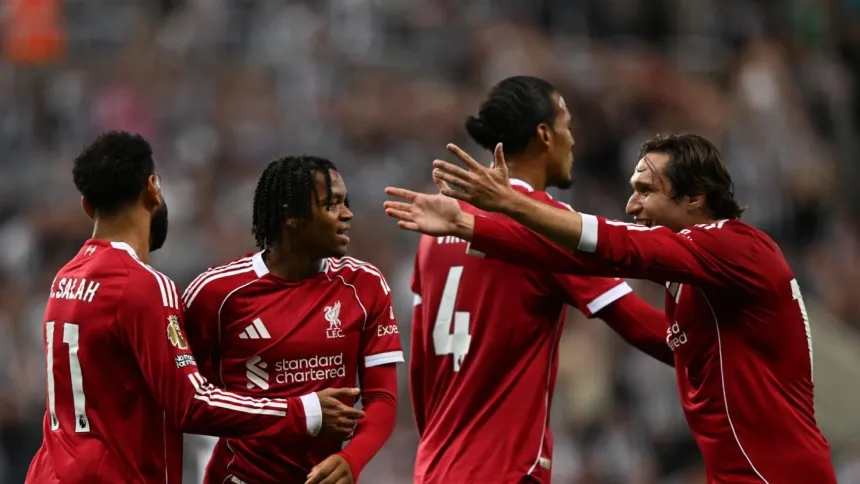
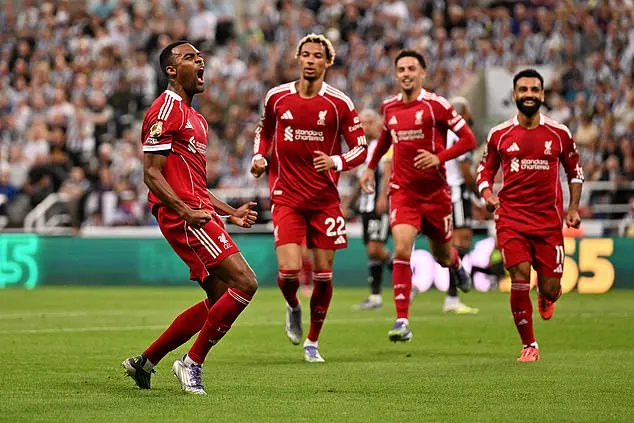
    Last night’s Liverpool vs Newcastle game was billed as the big Isak Derby, but as it unfolded at St. James’ Park, the spotlight didn’t just shine on the absent striker, it revealed a teenager who just made history.


    A Tale of Two Narratives

    Alexander Isak may have loomed large off the pitch, transfer rumors, a dramatic breakdown, Liverpool’s pursuit—but none of it mattered once the whistle blew. Instead, 16-year-old Rio Ngumoha rewrote the script with a stoppage-time winner in the 100th minute, becoming Liverpool’s youngest-ever scorer at 16 years, 361 days, and only the second 16-year-old in Premier League history to net a match-winner, joining Wayne Rooney.

    And then, there was Hugo Ekitiké, who Newcastle had eyed as an Isak replacement, scoring a goal so cool and clinical that, for a moment, it felt like he was telling Isak: “Isak Who?” His early second-half strike took just 20 seconds, and it doubled Liverpool’s lead.


    The Rollercoaster Match Timeline

    • First Goal: 35′—Ryan Gravenberch thunders in a low shot from distance to break the deadlock.
    • Red Card: Anthony Gordon lost his cool, catching Virgil van Dijk with a reckless studs-up challenge and saw red right before the break.
    • Second Goal: A split-second after halftime, Ekitiké slots home to put Liverpool 2–0 up.
    • Newcastle Fightback:
      • 57′—Bruno Guimarães heads in from a cross to bring Newcastle back into it.
      • 88′—Sub Will Osula levels with a close-range finish off a long punt forward.
    • Final Drama: 100′—Ngumoha curls in the winner, sealing a 3–2 Liverpool triumph.

    What Made The Isak Derby Special

    • Isak’s absence wasn’t a drawback—it set the emotional tone, but New storylines stole the night.
    • Ekitiké signaled “who?” with a strike that felt like a statement: precise, efficient, and timely.
    • Ngumoha is a club legend now—on debut, he entered the record books and delivered on the highest stage.
    • Newcastle showed grit. Down to 10 men and losing key players to injury, they staged a comeback that pushed Liverpool to the edge.

    Final Thoughts

    The “Isak Derby” was meant to highlight transfer tension, but instead, it became a coming-of-age tale for young Rio Ngumoha and a reminder that football writes its own stories. As for Ekitiké? His performance suggested he’s not just a No. 9 by necessity—he’s a match-winner in his own right.

    Liverpool leave Newcastle with a perfect start—two wins from two, but more importantly, they add a new legend to their ranks. Game on.

  • The Isak Derby: Transfer Tension Fuels Liverpool vs Newcastle Showdown

    The Isak Derby: Transfer Tension Fuels Liverpool vs Newcastle Showdown

    Liverpool travel to St. James’ Park for the first-ever “Isak Derby” as transfer drama over Alexander Isak fuels a high-stakes clash with Newcastle United.

    The Subplot: Isak Saga Adds Extra Edge

    This isn’t just another Liverpool match—it’s the Isak Derby. Alexander Isak’s public fallout with Newcastle has dominated headlines. He’s declared the relationship irreparable and Liverpool’s failed £110 million bid only added fuel to the fire.

    Eddie Howe has labeled the situation a distraction, while Liverpool boss Arne Slot insists his team has sufficient attacking alternatives beyond Isak.

    Team News & Tactical Notes

    Newcastle United

    • Formation: Expected 4-3-3 with Anthony Gordon spearheading attack and flanked by Elanga and Barnes.
    • Context: Without Isak, Newcastle will lean on collective strength and home advantage to unsettle Liverpool.

    Liverpool

    • Injuries: Right-back Jeremie Frimpong is sidelined with a hamstring injury; Conor Bradley has resumed training but remains doubtful. Arne Slot may field Joe Gomez or rotate with Endō or Szoboszlai.
    • Attacking Depth: Slot emphasized his confidence in players like Salah, Hugo Ekitike, Cody Gakpo, Florian Wirtz, and Chiesa to operate without Isak.

    Rivalry & Motivation

    Newcastle carry strong momentum, having beaten Liverpool 2–1 in the recent EFL Cup final—ending a 70-year trophy drought. Meanwhile, Liverpool are the defending Premier League champions, and revenge is a potent motivator.

    Records on the Line

    Liverpool can set two club records this match: scoring in the most consecutive games and the most consecutive away games.

    Predictions & Odds

    • Bookmakers favor Liverpool, continuing their strong away record at St. James’.
    • Talksport notes Hugo Ekitike as a likely impact player given his form.

    Head-to-Head Record

    • Last 5 PL meetings: Liverpool W4, Newcastle W0, Draws 1
    • Last meeting at St. James’ Park: Liverpool won 2-0 (August 2023).
    • Newcastle haven’t beaten Liverpool in the league since December 2015.

    Final Thoughts

    The “Isak Derby” isn’t just about 90 minutes of football—it’s about pride, power, and narrative. Newcastle aim to capitalize on home soil amid off-field chaos. Liverpool arrive with intent, history, and depth. Expect fireworks.

  • Red Devils Frustrated as Fulham Snatch a Point

    Red Devils Frustrated as Fulham Snatch a Point

    Fulham and Manchester United played out a thrilling 1–1 draw at Craven Cottage on Sunday, August 24, 2025. Despite United taking the lead, Fulham’s late equalizer ensured the spoils were shared in a match full of drama and momentum shifts.

    Match Summary

    United took the lead when Leny Yoro’s header deflected off Rodrigo Muniz into his own net. However, the lead was short-lived. Emile Smith Rowe, introduced as a substitute, equalized just 93 seconds later, finishing a well-timed cross from Alex Iwobi. Reuters

    Turning Points

    • Bruno Fernandes missed a crucial first-half penalty, skying the ball over due to a momentary distraction—an incident he later attributed to being inadvertently knocked by the referee. The GuardianTalkSport
    • After scoring, Manchester United turtled defensively, a shift that frustrated manager Ruben Amorim, who urged his side to “grow up” and trust their attacking instincts. The GuardianReuters
    • Marco Silva lauded Fulham’s response and squad perseverance, particularly praising the timely impact of substitutes like Smith Rowe. The GuardianThe Times

    Final Score

    Fulham 1–1 Manchester United

    • Goals: Muniz (OG, 1–0 United) | Smith Rowe (1–1 Fulham)

  • Fulham vs Manchester United: Can the Cottagers Stop Amorim’s Red Devils?

    Fulham vs Manchester United: Can the Cottagers Stop Amorim’s Red Devils?

    Fulham hosts Manchester United on Sunday, August 24, 2025, at Craven Cottage in a highly anticipated Premier League clash. Both sides are chasing early-season momentum and looking to make a statement.

    Team Form

    Fulham started their campaign with a hard-fought 2-2 draw against Brighton, rescued by Rodrigo Muniz’s stoppage-time equalizer. Marco Silva’s side will aim to capitalize on home advantage and frustrate United’s defense.

    Manchester United, under Ruben Amorim, opened the season with a narrow defeat to Arsenal but showed flashes of promise through new signings Bryan Mbeumo and Matheus Cunha. The Red Devils are seeking their first league win of the season.

    Key Matchups

    • Rodrigo Muniz vs United’s defense – The Brazilian striker’s aerial threat and physicality will be key for Fulham.
    • Bryan Mbeumo’s creativity – United’s summer signing has the pace and dribbling to unlock Fulham’s back line.
    • Midfield battle – Antonee Robinson’s forward surges and Fulham’s compact midfield will test United’s rhythm in possession.

    Team News

    • Fulham: Marco Silva will be without several squad players but is expected to field a strong XI led by Bernd Leno, Robinson, and Muniz.
    • Manchester United: Ruben Amorim could hand more minutes to new arrivals Benjamin Šeško and Matheus Cunha, while experienced stars remain central to his plans.

    Prediction

    Fulham are tough to beat at Craven Cottage, but United’s attacking depth could prove decisive. Expect a competitive game with chances at both ends.

    Predicted Score: Fulham 1–2 Manchester United

  • Part 2: Forget the Noise; Arsenal’s Recruitment Strategy Is About to Pay Off

    Part 2: Forget the Noise; Arsenal’s Recruitment Strategy Is About to Pay Off

    Patience Over Panic

    Just like in life, where we learn not to buy every trending gadget but save for what truly matters, smart clubs don’t spend whimsically. They invest sensibly.

    That’s exactly how Arsenal approached this summer. Instead of flailing with emotion, they reinforced carefully with what mattered.

    The Big Picture

    Arsenal have finished runners-up three seasons in a row:

    • 2022/23; 84 points (2nd)
    • 2023/24; 89 points (2nd), the second-highest in club history
    • 2024/25; 74 points (2nd), despite disruption

    They led the Premier League in set-piece goals in 2023/24 and remained defensively elite last season. You don’t dismantle that; you build on it.

    Key Departure

    Every rebuild starts with exits. The biggest?

    • Thomas Partey; After 167 Arsenal appearances, the midfield stalwart left for Villarreal on a free (Reuters). His departure wasn’t sentimental; it opened a gap that needed filling with both experience and energy.

    Purposeful Arrivals

    Instead of chasing headlines, Arsenal signed profiles that fit:

    • Martín Zubimendi → midfield control and press-resistance
    • Viktor Gyökeres → proven No.9 with physical presence
    • Noni Madueke → 1v1 wing dynamism
    • Christian Nørgaard → depth + leadership
    • Kepa Arrizabalaga → goalkeeping reinforcement
    • Cristhian Mosquera → young, versatile centre-back

    And now, the headline act: Eberechi Eze.
    The Crystal Palace star is set to arrive imminently, adding exactly what Arsenal have lacked; a creative, ball-carrying midfielder who can break lines, beat defenders, and unlock low blocks.

    Eze isn’t just flair; he’s production: dribbles, set-pieces, goals from midfield. In a side often criticised for lacking unpredictability in the final third, he changes the equation.

    Timing Over Drama

    Transfers closed in phases; not based on panic, but process.

    • Early arrivals: Zubimendi, Nørgaard
    • Mid-window: Madueke, Gyökeres
    • Late-window: Mosquera
    • Final touch: Eze, a deal negotiated patiently to land a player Arteta specifically wanted

    This wasn’t chaos; it was methodical negotiation, timing, and relationship management.

    Profiles Over Fame

    Arsenal’s summer is proof that names don’t win titles; fit does.

    • Zubimendi → midfield security
    • Gyökeres → box threat + set pieces
    • Madueke → wing penetration
    • Nørgaard → steady reliability
    • Mosquera → defensive depth
    • Eze → creativity, dribbling, line-breaking unpredictability

    Each signing complements the other, rather than crowding the squad with redundant star power.

    Early Evidence

    Day 1 of the season? Arsenal delivered a clinical away win at Old Trafford; sealed with a set-piece header from last summer’s signing. That’s not hype, that’s maturity. With Eze’s imminent arrival, the attack could find the extra gear that turns runners-up into champions.

    The Long View

    • High baseline; Three consecutive 2nd-place finishes prove elite consistency.
    • Marginal gains; Defence is already solid, add more goals, and the title race swings.
    • X-factor incoming; Eze brings creativity Arsenal haven’t had since peak Özil.

    Wrap-Up: A Summer of Purpose

    This transfer window wasn’t about shiny headlines. It was about building tools the squad lacked. Eze’s arrival gives this plan its cutting edge.

    Coming up in Part 3, we’ll look at the youth revolution; the gamble on Hale End graduates that could turn this blueprint into something uniquely Arsenal.

    Part 1 showed how Arsenal’s consistency set the stage.

    Part 2 proves their recruitment was deliberate, not emotional; capped with Eze’s dynamism.

  • From Palace King to Emirates Crown Jewel: Why Eze Changes Everything for Arsenal

    From Palace King to Emirates Crown Jewel: Why Eze Changes Everything for Arsenal

    Arsenal’s Transition Crisis… Meet the Antidote

    As someone who watches almost every Arsenal game, I can’t help but sigh at how often we waste transitions. We win the ball, there’s space to attack, and instead of punishing teams, we stall or turn it over. Arteta’s side is tactically solid, but when it comes to rapid, incisive counters or breaking down stubborn low blocks, we still fall short. The truth is simple: we lack transitional players.

    That’s where Eberechi Eze comes in.

    Why Eze Is the Missing #10 Arsenal Need

    Eberechi Eze thrives in the exact areas where Arsenal struggle. He is an elite dribbler, ball carrier, and passer. He can run in behind, dictate attacks, and he’s comfortable both from the left wing and as a number 10.

    And the numbers back it up:

    • 3.59 dribbles attempted per game, 2.03 successful – ranking among the best in the league (FootyStats)
    • 2.06 key passes per game – 94th percentile (FootyStats)
    • 0.28 assists per 90 with 0.30 xA – again top percentile (FootyStats)
    • 3.6 shots per 90 – bettered only by Haaland, Jota, Palmer, Madueke, and Enciso (Opta Analyst)

    While Ødegaard gives Arsenal incredible control, he isn’t the type to accelerate play or constantly make runs off the ball. Eze is. And that’s why he feels tailor-made for this team.

    What Does That Mean for Arteta’s System?

    Picture this: Eze playing as a right-sided 10, constantly interchanging with Saka. The underlaps, overlaps, and direct runs would be a nightmare for defenders. Ødegaard can dictate tempo, but Eze can be the spark that turns dominance into goals.

    He also offers versatility. Whether he’s central or drifting left, he provides penetration that Arsenal currently lack. For a squad that already boasts depth, Eze gives Arteta another dimension—control plus chaos.

    The Left-Wing Factor

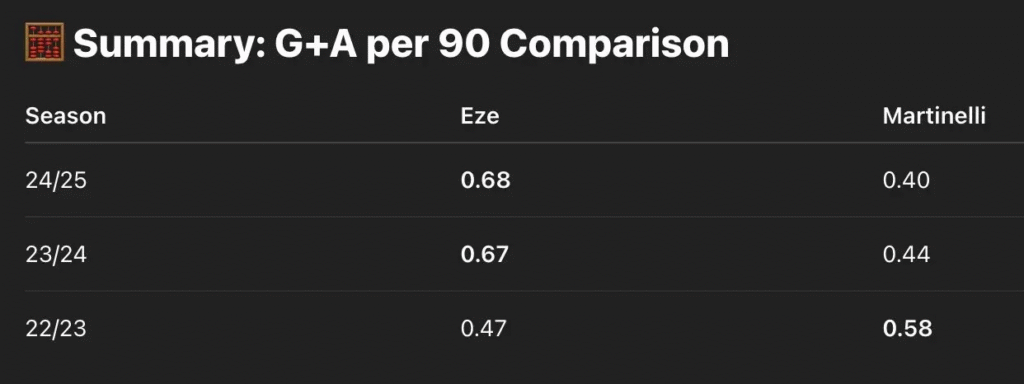
    Another underrated part of Eze’s game is how effective he can be on the left wing. This matters because while Martinelli and Trossard are excellent, their profiles are similar in some ways.

    • Martinelli is explosive and direct, but he relies heavily on his pace and instinctive finishing. He thrives in space but can get crowded out against low blocks.
    • Trossard offers smart movement and link-up play, but he’s more of a tidy connector than a line-breaker.

    Eze brings something different. He can isolate a defender one-on-one and beat him, or he can cut inside and carry the ball through midfield. His ability to combine dribbling with creative passing means he isn’t just a threat to score—he creates for others too. On the left wing, he would give Arsenal a different dynamic: less predictable, more versatile, and harder to shut down.

    That flexibility makes him even more valuable. He can rotate with Martinelli and Trossard while still offering qualities neither of them bring consistently.

    Proven Performer Under Pressure

    Eze isn’t just about highlight reels, he produces when it matters.

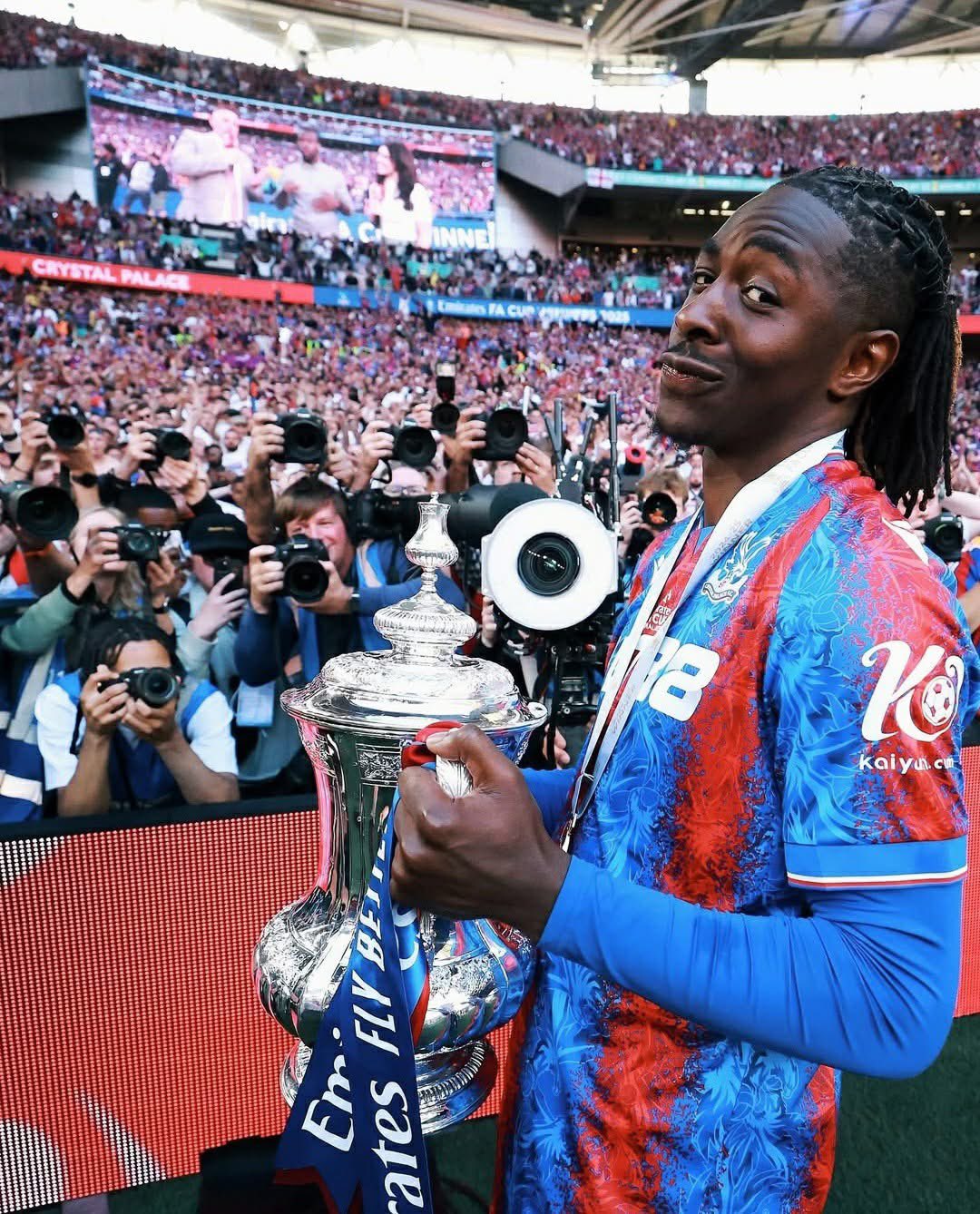
    • He scored from outside the box in the FA Cup semi-final vs Villa, then sealed Palace’s first-ever major trophy with a volley against Manchester City in the final (Wikipedia).
    • He contributed goals and assists against top opposition like City, Arsenal, Forest, and Villa during Palace’s cup run (Opta Analyst).
    • In the quarter-final against Fulham, he scored and assisted in quick succession to carry Palace through (Vanguard News).

    These aren’t just good performances. They’re big-game moments. Arsenal need more of that.

    Arsenal’s Elite-Level Attack… Finally Complete

    Arsenal’s attack is stacked. Saka, Madueke, Gyökeres, Ødegaard, Havertz—all give Arteta variety and control. What they haven’t had is the individual brilliance that consistently breaks games open in transition. Eze brings that.

    Think back to City at their peak: Haaland, De Bruyne, Mahrez. Or Liverpool at their best: Salah, Trent, plus four or five forwards capable of deciding games. Arsenal finally have the makings of that same unpredictability.

    Bottom Line

    Arsenal already have the depth and the system. What they needed was transitional quality and direct individualism in the final third. That’s exactly what Eberechi Eze provides.

    He won’t just slot into Arteta’s side, he’ll elevate it. From the moment he pulls on the shirt, his ability will be undeniable. The dribbling, the creativity, the transitional threat—it’s all there.

    With Eze, Arsenal won’t just be contenders. They’ll be winners.

  • When We Seek Perfection in Imperfect Lives: Why Arsenal’s Strategy Hits Home (Part 1)

    When We Seek Perfection in Imperfect Lives: Why Arsenal’s Strategy Hits Home (Part 1)

    We all know life isn’t perfect, bills pile up, deadlines loom, relationships need work. And yet, on match day, when your team doesn’t start fast or falters for a few weeks, it’s easy to demand perfection. That’s exactly why we’re fans. We crave it. But life, and football rarely give it to us. Emotional reactions are understandable, but decision-makers have to build with reality, patience, and resources, not feelings.

    That’s the backdrop for Arsenal’s 2025/26 season. Their story isn’t built on emotional highs or reckless spending. It’s built on consistency, smart planning, and purposeful moves. And the results show it.

    From 8th to Three Successive Runner-Up Finishes

    In just four seasons under Mikel Arteta, Arsenal went from 8th-place finishes in 2020–21 and 2021–22 to three back-to-back second-place finishes from 2022–23 through 2024–25 (Transfermarkt, Wikipedia).


    A Point Collection That Sustains Ambition

    • 2022–23: 84 points (2nd) (Wikipedia)
    • 2023–24: 89 points (2nd) — Arsenal’s second-highest ever (Wikipedia)
    • 2024–25: 74 points (2nd), despite disruptions (Wikipedia)

    That adds up to 247 points in three seasons; just four points shy of Manchester City’s 251, and well ahead of Liverpool’s 233 (The Sun). The engine isn’t broken, it’s performing.


    Kicking Off 2025/26 with Purpose

    The new season has barely begun, and Arsenal made a statement with a win at Old Trafford. That result shortened their title odds from 5/4 to 2/1 (TalkSport). Pressure is higher than ever; legend Martin Keown’s expectation is simple: it’s time to deliver silverware. (TalkSport)


    Why This Phase Really Matters

    This isn’t emotional football. It’s strategic:

    • Consistency over flashes
    • Recruitment, not spectacle
    • Culture over individual brilliance

    We live imperfectly; but to build something lasting, especially in football, you must plan, be patient, and stay grounded.


    Coming Up in Part 2: Recruitment as the Foundation

    Next up, I’ll dive into why this summer’s transfer window wasn’t about headlines; it was about precise, purposeful reinforcements.

  • Benjamin Šeško: A Flower Waiting to Bloom

    Benjamin Šeško: A Flower Waiting to Bloom

    Too often, young players are dismissed prematurely because of superficial numbers. We’ve seen this pattern repeat itself time and time again. Years back, people were quick to call Alexander Isak a flop because he only scored six goals in a particular season. What they missed was the bigger picture — his movement, technical quality, and potential were clear. Fast forward to today, Isak is one of the most complete forwards in the Premier League.

    Now that same short-sighted analysis is being applied to Benjamin Šeško. The narrative goes: “he’s not good enough” or “he hasn’t proven anything yet.” But here’s the truth — Šeško has already scored over 120 career goals across club and international football by the age of 21. Just last season (2024/25), he hit 18 goals for RB Leipzig in all competitions, in a side that wasn’t always firing in attack. Despite the circumstances, he showed remarkable progress in his positioning, decision-making, and composure in front of goal.

    Performance vs Results

    This brings us to a crucial distinction: performance-based analysis vs result-based analysis.

    • Result-based analysis only cares about the outcome — goals, assists, wins. It rarely asks how those outcomes were achieved or what limited them.
    • Performance-based analysis digs deeper. It looks at a player’s off-the-ball runs, link-up play, pressing, chance creation, and decision-making.

    When you’re evaluating a young striker like Šeško, performance-based analysis matters more. Because the question isn’t “what is he today?” The question is: “what could he become at 25 or 26 with the right development path?” That requires nuance and foresight, not just stat-checking.

    The Mental Side of the Game

    Talent is nothing without the mentality to match it. Not every young player can carry the weight of expectation, adapt to tactical shifts, or stay sharp when the goals aren’t flowing.

    Šeško has already shown mental resilience. He’s competed in top leagues, faced pressure at international level, and continued improving despite not always being in the most favorable setups. That kind of character is what separates long-term professionals from short-term hype.

    The Gyökeres Comparison Trap

    Some critics are already comparing Šeško unfavorably to Viktor Gyökeres. But let’s rewind. At 21, Gyökeres was still finding his feet in the lower tiers of English football. Nobody was calling him elite. Today, he’s thriving because he found the right system and steady development path.

    So why deny Šeško that same grace? In fact, you could argue he’s ahead of where Gyökeres was at the same age.

    A Cameo Worth Noting

    Sunday against Arsenal, Šeško made a short cameo, but even in those few minutes you could see flashes — the movement, the physicality, the hunger to make an impact. It was only a glimpse, but it’s a reminder: growth takes time, and development isn’t linear.

    Not every appearance will be a headline. Sometimes, it’s just about planting seeds.

    Final Word

    Šeško has the physical tools, technical skill, and mental strength to become elite. What matters now is time, patience, and the right environment. He doesn’t need to be the finished article today. What matters is what he can become.

    So yes, support Isak. Celebrate Gyökeres. But stop using one player’s rise as an excuse to bury another’s potential. That mindset does nothing but fuel toxic discourse.

    Šeško may just be a flower waiting to bloom. Yesterday’s cameo was just a smile at what could be ahead. Give him time, and he might just surprise everyone.

  • Football Is a Team Sport: Different Profiles Build Great Teams

    Football Is a Team Sport: Different Profiles Build Great Teams

    When we were younger, football felt so simple. On the playground, roles came naturally. The fastest kids went to the wing. The ones who could dribble got the ball more. The big and strong ones defended. The kid with the thunderous shot stayed up front.

    Everyone had a profile. Everyone had a role.

    So why, as fans, have we grown up and forgotten this? Why do we now criticize professional players for not being “complete” when even the best teams are built on different profiles working together?

    The truth is, elite football isn’t about having 11 flawless players. It’s about balance. A team needs variety:

    • The dribbler who pulls defenders out of shape.
    • The runner who stretches the pitch and presses.
    • The playmaker with vision and finesse.
    • The striker who might lack a silky touch but finishes ruthlessly.
    • The defender who organizes and refuses to be beaten.

    Not every player has to excel at everything. Even at the top level, strengths and weaknesses coexist. Team construction is an art — the puzzle is completed with pieces that are imperfect but purposeful.

    Look at Manchester City. The side that dominated under Pep Guardiola thrived because of its mix of profiles. Raheem Sterling wasn’t the cleanest technician, but he stretched defenses. Fernandinho, never flashy, controlled transitions with his positioning and tactical fouls. Gabriel Jesus wasn’t the most clinical, but his pressing and link-up play were invaluable. Then you had elite creators like Kevin De Bruyne and David Silva, plus lethal finishers like Leroy Sané.

    That balance made them nearly unstoppable. But in the 2023–24 season, cracks showed as some profiles weren’t replaced. Without Sterling or Mahrez, City lost 1v1 threat on the wings. Without Jesus, they lacked chaos and pressing energy up front. The system became more predictable — not because individuals got worse, but because the variety of profiles shrank.

    This is the bigger picture: football isn’t about 11 identical players. It’s about profiles that complement each other. Teams need runners, creators, destroyers, leaders, and specialists.

    That’s what makes football the ultimate team sport.